
Vote swapping might have delivered Florida to Al Gore—until government officials shut it down and changed the course of history.
In November, 2000, George W. Bush famously became President of the United States because of just 537 votes in the single state of Florida (out of 105,396,641 total votes cast nationwide). Third party candidate Ralph Nader, meanwhile, garnered nearly 100,000 votes in that state, leading many Americans to call him the “spoiler” who split the progressive vote and gave the election to Bush. But the truth is that vote swapping was shut down just when it could have changed the election – and the fate of the world.
Ralph Nader was a well-known champion of ordinary Americans in their struggles against giant corporations. He led national efforts that forced the automotive industry to build safer cars, forced the nuclear power industry to cancel dozens of planned nuclear power plants, forced agribusiness to label what went into our foods, and forced Congress to cut government secrecy with the Freedom of Information Act. And in the year 2000, he was the Green Party candidate for President of the United States.
Millions of Americans wanted to vote for Ralph Nader in the 2000 election, but not if it meant helping Republican George W. Bush get elected. In that election, there were roughly 20 red states that were almost certain to vote for Bush, and another 20 blue states that were almost certain to vote for Al Gore, the Democratic candidate. That left only about 10 purple states that could go either way. (Al Gore later became famous for his crusade to stop global warming and would have made a very different President from George W. Bush.)
A young law professor named Jamie Raskin (before he himself became a Member of Congress) had a brilliant suggestion: why not get people in purple states to vote for Al Gore, in exchange for people in red and blue states voting for Ralph Nader? If 100,000 people swapped their votes in that way, Raskin calculated that Al Gore would win the Presidency and Ralph Nader would get the 5% of total votes needed to qualify for government funding next time.
Raskin published his proposal in Slate magazine on October 25, 2000 – just two weeks before the election scheduled for November 7. Unbeknownst to Raskin, a website called voteexchange.org was already up and running by October 1st of that year, offering voters an opportunity to do exactly what Raskin proposed. Voteexchange.org received very little attention, however, and in the end claimed to have facilitated the exchange of just 230 vote swaps.
But as soon as Raskin’s article came out, vote swapping was suddenly all the rage. A second website, NaderTrader.org, had just been launched on October 23, and within one week it registered nearly 200,000 hits. Meanwhile, three more vote swapping websites were launched during that same week, including VoteSwap2000.com, which began operations on October 26. And by the end of that last week of October, there were no less than 16 websites devoted to vote swapping. Between them, these sites claimed to have had more than 2.8 million hits in just one week. Over 36,000 people had signed up to swap, and at least 16,000 swaps had taken place.
Then, on October 30, with vote swapping really just getting underway and only one week left before the election, the Republican Secretary of State for California, Bill Jones, sent a letter to the owners of VoteSwap2000.com stating that they were in violation of state election laws and must immediately cease operating.
VoteSwap2000 shut itself down, and many other vote swapping sites followed suit. Some of the others continued, but with a disclaimer warning people not to swap votes if they lived in California. But on October 31, the Secretary of State for Minnesota declared vote swapping illegal in that state, and on November 1, the Secretary of State for Arizona did the same. Oregon decided it was illegal on November 3 – and then announced it was legal after all on November 4. (New York also sent a “cease and desist” letter to vote swapping sites, saying that they violated state election laws, but other states, including Maine, Nebraska and Oregon, assessed that swapping votes was not the same as buying votes and was thus allowable.)
It was not until 2007 that a Federal Court finally issued a determination that vote swapping is not illegal but is in fact a right guaranteed by the First Amendment. That was after six plaintiffs, supported by the American Civil Liberties Union (ACLU), filed a lawsuit against Bill Jones for violating their rights. That lawsuit was initially dismissed by a California court, and went through several court cases before a final verdict by the Ninth Circuit Court of Appeals. A subsequent attempt to revisit this case was denied in 2008, thus bringing this saga to an end and establishing the precedent that still holds today.
What Jones and others tried to argue was that swapping votes was equivalent to buying votes, which is clearly illegal under state and federal law. While no money may be changing hands, Jones claimed that your vote is a thing “of value” – and therefore to offer it to someone else is offering them something of value in exchange for voting the way you want them to.
The Federal Court determined, however, that vote swapping is not equivalent to vote buying, but is a form of free speech and thus a fully protected right under the US Constitution.
Meanwhile, the damage was done. Of the 16,000 swaps that took place during that one week of vote swapping, 1,412 were in Florida. If vote swapping had not been prematurely quashed by Bill Jones, but allowed to continue for another week up to election day, we could imagine that at least another 1,412 votes would have been swapped in Florida in that time (probably many times more). And that would have meant Al Gore winning Florida – and thus the Presidency – by at least 875 votes, instead of losing by 537 votes.
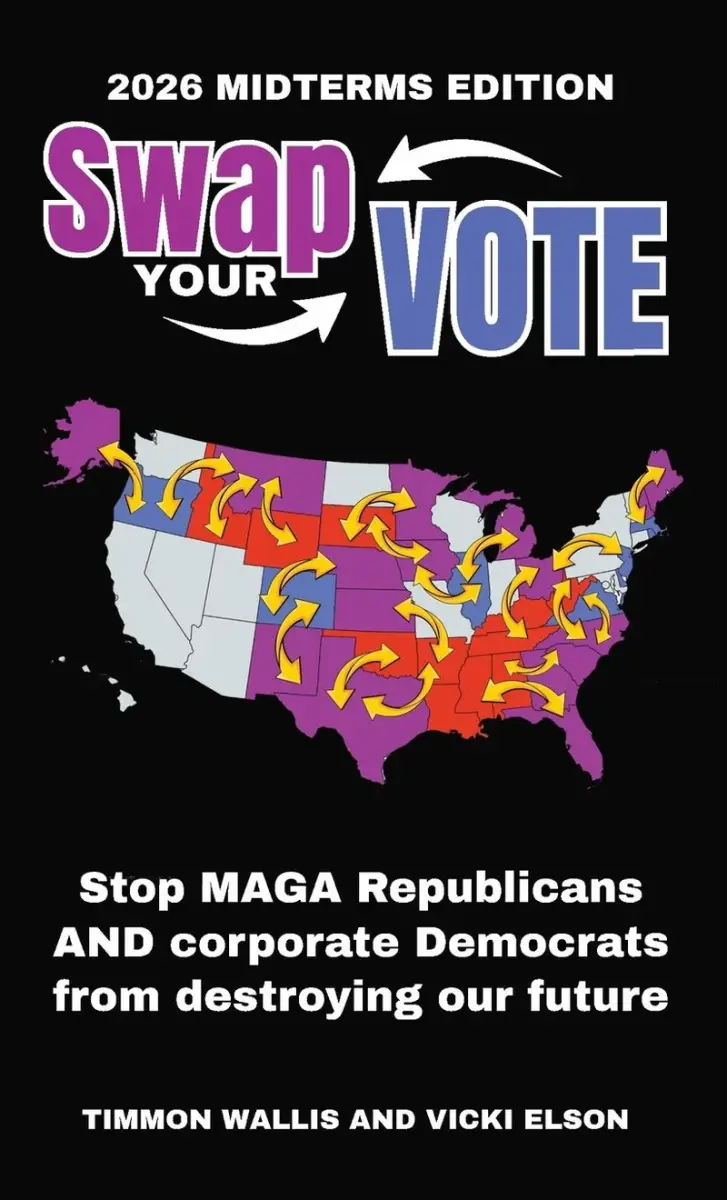
Vote swapping is once again being promoted in 2026 – this time as a counter-balance to persistent efforts by Trump and MAGA Republicans to fiddle the midterms in their favor. Voters in solid red and blue states and districts can help get more votes for Democrats where it really matters by swapping their vote with a voter in a purple “swing” state or district. Voters in purple states and districts get to see an increase in votes for third parties nationwide without risking a Republican winning where they are. Go to www.votetosurvive.org for more information.
From the forthcoming book, Swap Your Vote: Stop MAGA Republicans AND corporate Democrats from destroying our future (Indispensable Press, Sept 1, 2026) This extract first published in LA Progressive, July 14, 2026. The opinions expressed here are solely the author’s and do not reflect the opinions or beliefs of the LA Progressive.